Average salary in Switzerland in 2026: the official figures and what job ads offer
By Nishant Modi, Founder of Careerkit, based in Zurich · Published 9 November 2026

The median salary for a full-time job in Switzerland is CHF 7,024 a month before deductions, according to the Federal Statistical Office’s latest earnings survey, which covers 2024 and was published in November 2025. Over 12 months that is about CHF 84,300 a year. A second official survey, the Swiss Labour Force Survey, put median full-time earnings for 2025 at CHF 87,000 a year. Around those midpoints, pay moves a lot: by region, by sector, by education and, for people moving here, by residence permit.
This guide gives you each of those numbers with its official source. It also adds something the official surveys cannot show: what employers put in their job ads this year. We looked at 182,473 Swiss job ads published between January and October 2026, and only 2.1% of them stated a salary at all.
What the average salary in Switzerland means
Swiss wage statistics report the median, not the arithmetic average. The median is the middle salary: half of full-time employees earn more and half earn less. The statistical office points out that the median should not be confused with the average wage, which a small number of very high earners pull upwards. When you search for the average salary in Switzerland, the median is the figure that tells you what typical pay looks like.
Per month and per year
In 2024 the national median for a full-time job was CHF 7,024 a month, up from CHF 6,788 in 2022. The lowest-paid 10% of full-time employees earned less than CHF 4,635 a month and the best-paid 10% more than CHF 12,526. The survey is large, with answers from around 34,000 companies covering 2.9 million employees, and it is run every two years.
The survey’s monthly figure already includes a twelfth of the 13th monthly salary and of any bonus, so multiplying it by 12 gives a fair yearly figure: about CHF 84,300 for the median, CHF 55,600 for the bottom 10% line and CHF 150,300 for the top 10% line. That 13th salary is the norm here. In 2024, 75.9% of employees received one, and 32.6% received a bonus worth CHF 11,967 a year on average. When an employer quotes a yearly salary, ask whether it is paid in 12 or 13 instalments before you compare it with a monthly figure.
The newer yearly figure: CHF 87,000
The Labour Force Survey measures pay differently. Its income figure covers earnings from both employment and self-employment, and on that basis median gross income for a full-time job was CHF 87,000 in 2025, up from CHF 81,500 in 2024. Use it as the most recent yearly snapshot. For comparing jobs by region, sector or permit, use the earnings survey’s CHF 7,024, because that is the survey with the detailed breakdowns below.
Average salary by region
Where you work changes the median by almost CHF 1,800 a month between the best-paid and the lowest-paid region.
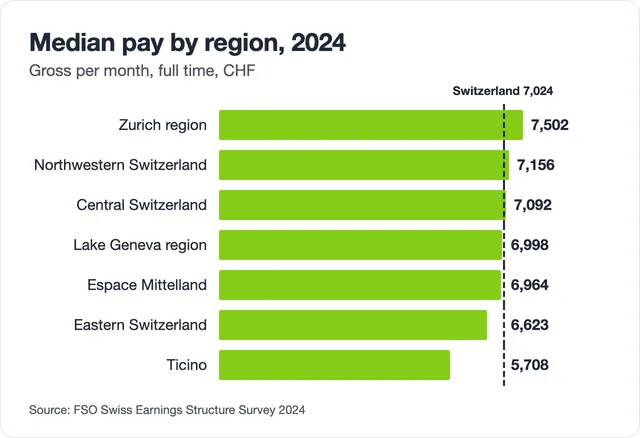
The Zurich region has the highest median at CHF 7,502 a month, about CHF 90,000 a year, and Ticino the lowest at CHF 5,708. Between them sit Northwestern Switzerland, which includes Basel, at CHF 7,156, Central Switzerland including Zug at CHF 7,092, the Lake Geneva region at CHF 6,998, Espace Mittelland including Bern at CHF 6,964, and Eastern Switzerland at CHF 6,623.
The gap is much wider at the top than at the bottom. The best-paid 10% earned more than CHF 13,970 a month in the Zurich region, CHF 12,636 around Lake Geneva, CHF 11,030 in Eastern Switzerland and CHF 10,012 in Ticino, while the bottom 10% lines ranged only from CHF 4,761 in the Zurich region to CHF 3,783 in Ticino. The statistical office explains the regional differences mainly by where high-value industries are concentrated. If you are comparing offers in different cities, judge each one against its own region, then look at live roles in Zurich, Basel, Geneva or Lugano.
Average salary by sector
Your industry moves pay more than your city does. The spread between the best- and worst-paid sectors is about CHF 10,000 a month.
At the top in 2024 were tobacco at CHF 14,304 a month, banks at CHF 10,723, pharmaceuticals at CHF 10,159 and research and development at CHF 9,139. IT services had a median of CHF 9,874. In the middle were machinery at CHF 7,632, wholesale at CHF 7,478, aviation at CHF 7,134 and construction at CHF 6,616. At the bottom were retail at CHF 5,214, restaurants at CHF 4,744, accommodation at CHF 4,715 and personal services at CHF 4,496.
Low pay is concentrated in a few sectors. The official low-wage line is CHF 4,683 a month for a full-time job, and 56.3% of jobs in personal services and 48.7% in accommodation fell below it, against 0.6% at banks. For the legal floor in the cantons that have one, see our minimum wage guide. Many roles that only need English are in the well-paid group: browse current openings in finance, IT and software and pharma and science.
Salary by education and responsibility
Education sets the first level. With a university degree the median full-time salary was CHF 10,533 a month, with a degree from a university of applied sciences CHF 9,288, and with a Swiss federal VET certificate (EFZ) CHF 6,390.
Responsibility then moves it further. A university graduate in a role with a high level of responsibility earned a median of CHF 14,409 a month, against CHF 8,645 in a role without responsibility. With an EFZ the two figures were CHF 8,252 and CHF 6,162. So when you benchmark an offer, compare it with people at your own level, not with the national median.
Salaries for foreign workers by permit
Whether foreign employees earn more or less than Swiss employees depends on the kind of job.
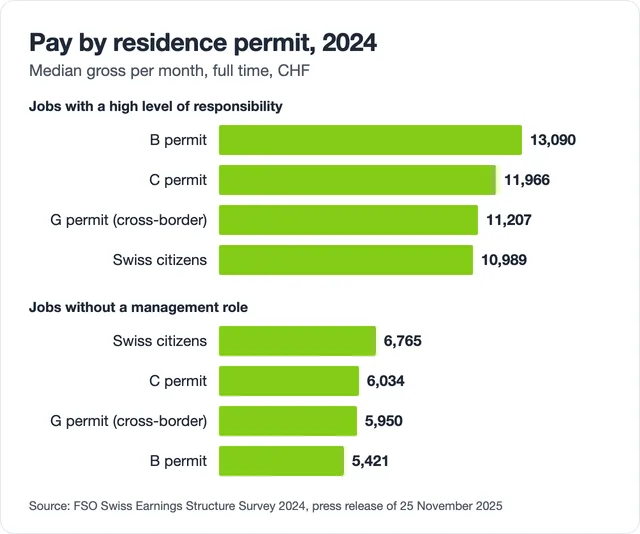
In jobs with a high level of responsibility, foreign employees earned more than Swiss employees in 2024. B permit holders had a median of CHF 13,090 a month, C permit holders CHF 11,966 and cross-border commuters on a G permit CHF 11,207, against CHF 10,989 for Swiss citizens. In jobs without a management role it was the other way round: Swiss employees earned CHF 6,765, C permit holders CHF 6,034, G permit holders CHF 5,950 and B permit holders CHF 5,421.
If you are not an EU or EFTA citizen, your offer also has to pass a pay check before you can start. Your salary and employment terms must match local, professional and sectoral conditions for the permit to be approved, which in practice means the employer has to pay at least what is usual for that job in that region. Our guide to Swiss work permits explains how each permit works for EU, UK and other applicants.
What 2026 job ads show about pay
The official surveys ask employers what they paid. Job ads show what employers offer when they hire, so we looked at those too: every Swiss job ad that Careerkit’s job board collected between 1 January and 31 October 2026, 182,473 ads after removing duplicates and recruitment agencies.
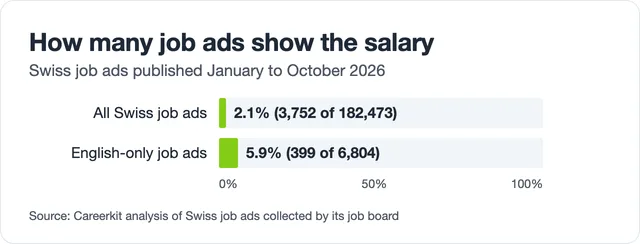
Only 3,752 of them, 2.1%, stated a salary. Ads where English is the only language required did a little better, with 399 of 6,804, or 5.9%. In practice you will rarely see the pay before you apply, so expect to name a number yourself, in the application form or in the first interview. If you are still wondering whether you can work here in English at all, start with this guide to working in Switzerland in English.
What the ads that do show pay offer
We kept the full-time ads with a yearly salary in Swiss francs, 2,427 ads from 533 employers, and took the middle of each advertised range. The median was CHF 80,000 a year, and half of the ads fell between about CHF 64,500 and CHF 109,600. That sits close to the official figures above, which is a useful check. It is still a small and uneven slice of the market: 1,497 of the 2,427 ads came through Job-Room, the public employment service’s job platform.
The English-only slice is more uneven still. A few large international employers publish a range in nearly every ad, and two of them, Novartis and CERN, make up about two thirds of the English-only ads with a full-time yearly salary. So we report those figures for what they are, individual employers’ ranges, and not as a figure for English-speaking jobs in general.
Employers that publish their pay ranges
These four international employers published the most salary ranges in English-only ads this year. The counts below cover all their Swiss ads in 2026 with a full-time yearly salary, and a typical range means the median low end and the median high end of the ranges each one advertised.
- Novartis: more than 200 ads, typical range about CHF 126,000 to CHF 234,000 a year.
- Microsoft: 31 ads, typical range about CHF 146,200 to CHF 245,900 a year.
- Swiss Re: 31 ads, typical range about CHF 107,000 to CHF 161,000 a year.
- CERN: 100 ads, mostly fellowships, graduate and technical posts, with ranges most often of CHF 63,192 to CHF 69,516 or CHF 76,464 to CHF 84,048 a year.
Ranges this wide cover several job levels. Place yourself inside them by seniority and responsibility, using the education and responsibility figures above, rather than asking for the top by default.
How we counted
The ads were published between 1 January and 31 October 2026 and collected by Careerkit’s Swiss job board from employer career sites and Swiss job portals. We removed duplicates and recruitment agencies. English-only means English is the only language the ad requires. For the salary figures we kept full-time roles with a yearly salary in Swiss francs between CHF 20,000 and CHF 500,000 and used the midpoint of each range, leaving out part-time roles, internships and apprenticeships. We read the data on 9 November 2026.
Is CHF 100,000 a good salary in Switzerland?
It depends on your sector and region, so here are the three amounts people ask about most, set against the official figures. All are gross, full time.
CHF 100,000 a year
That is about CHF 8,333 a month over 12 months. It is above the national median of CHF 7,024 and above the Zurich region median of CHF 7,502, but well below the line for the best-paid 10%, which is CHF 12,526 nationally and CHF 13,970 in the Zurich region. In banking or pharma, where the medians are CHF 10,723 and CHF 10,159 a month, it would be below typical pay for the sector.
CHF 80,000 a year
About CHF 6,667 a month: a little below the national and Zurich medians, and well above the Ticino median of CHF 5,708. It is also the median of the job ads with a stated salary that we analysed for 2026.
CHF 5,000 a month
About CHF 60,000 a year. It is above the official low-wage line of CHF 4,683 a month but below the median in every region, including Ticino.
Remember that these are gross figures. Social insurance and pension contributions, and for many foreign workers withholding tax, come off before your pay reaches your account, and the amounts depend on your age, canton and pension fund. To look up pay for a specific job and profile, the statistical office runs a free salary calculator, Salarium.
Using these numbers when you apply
With so few ads showing pay, the salary question usually lands on you. A vague answer makes you look unprepared, and a number from your home country can be far off. Give a range anchored on the figure for your sector, region and level of responsibility, and quote it the way Swiss employers do: yearly, gross, with the number of monthly payments.
Before: My salary expectation is negotiable.
After: My salary expectation is CHF 105,000 to 115,000 a year gross, paid in 13 instalments, in line with senior finance roles in the Zurich region.
Before: I am looking for something similar to what I earn now.
After: I currently earn the equivalent of CHF 82,000 a year. For this role in Basel I am asking for CHF 95,000 to 100,000, which reflects pay for similar roles in the region.
Your CV has to earn the interview before any of this matters. If yours is still in another country’s format, rebuild it to Swiss conventions in English with Careerkit’s free CV builder, and state your salary expectation and permit status in a short cover letter with the cover letter builder. Then browse all English-speaking jobs in Switzerland open today, or follow our step-by-step guide to getting hired here.
FAQ
What is the average salary in Switzerland?
The median full-time salary was CHF 7,024 a month gross in 2024, about CHF 84,300 a year including the 13th salary, according to the Federal Statistical Office. The Swiss Labour Force Survey put median full-time earnings at CHF 87,000 a year for 2025.
What is the average salary in Zurich?
The Zurich region had the highest median in Switzerland in 2024, CHF 7,502 a month gross for a full-time job, or about CHF 90,000 a year. The best-paid 10% there earned more than CHF 13,970 a month.
Is CHF 100,000 a good salary in Switzerland?
At about CHF 8,333 a month it is above the national median of CHF 7,024 and the Zurich median of CHF 7,502, but below the top 10% line of CHF 12,526. In banking and pharma, where medians are above CHF 10,000 a month, it is below typical pay.
Is CHF 80,000 a good salary in Switzerland?
It works out at about CHF 6,667 a month, slightly below the national median of CHF 7,024 and above the Ticino median of CHF 5,708. It matches the median of the 2026 Swiss job ads with a stated salary that Careerkit analysed.
Which jobs pay the most in Switzerland?
By sector, tobacco (CHF 14,304 a month), banks (CHF 10,723), pharmaceuticals (CHF 10,159) and IT services (CHF 9,874) had the highest medians in 2024. By profile, university graduates in roles with high responsibility earned a median of CHF 14,409.
Do foreigners earn less in Switzerland?
It depends on the job. In roles with high responsibility, B permit holders earned a median of CHF 13,090 a month against CHF 10,989 for Swiss citizens in 2024. In roles without a management function, Swiss employees earned more: CHF 6,765 against CHF 5,421 for B permit holders.
Conclusion
The middle full-time salary in Switzerland is CHF 7,024 a month, about CHF 84,300 a year, and the newest yearly figure is CHF 87,000. Zurich pays the most and Ticino the least. Banks, pharma and IT sit well above the median, hospitality and retail well below, and in senior roles people on a B permit out-earn Swiss citizens. Job ads will rarely tell you the number, since only about 2% show one, so do the benchmarking yourself before you apply. When you are ready, the live list of English-speaking jobs is updated every hour.
Ready to look? Browse 2,200 English-speaking jobs in Switzerland.