The Swiss C permit in 2026: when you qualify, the language rules and what changes
By Nishant Modi, Founder of Careerkit, based in Zurich · Published 10 November 2026

The C permit is the Swiss settlement permit. It is in principle valid without a time limit, and only the card itself is reissued every five years. It frees you from the conditions attached to a B permit: you can change job and canton freely, you stop paying tax at source, and it is the permit you need before you can apply to become Swiss.
When you can get one depends on your nationality: after five years for citizens of most western EU countries and EFTA, after ten for everyone else, with an earlier route for people who are well integrated. This guide covers each route, the language levels, what the permit changes in practice and how you can lose it. If you are still on your way to Switzerland, start with our overview of Swiss work permits and the guide to the B permit.
After five years: EU and EFTA citizens with an agreement
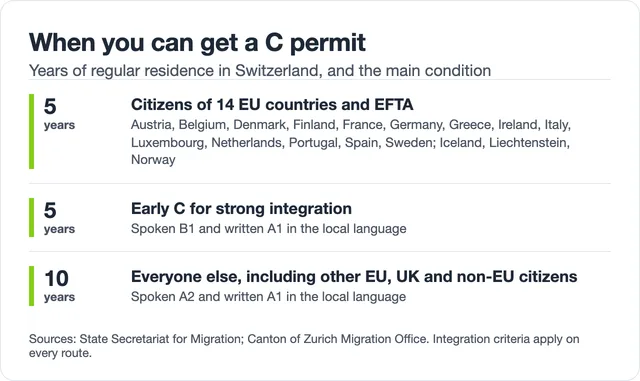
Switzerland has settlement agreements with some countries. Citizens of Austria, Belgium, Denmark, Finland, France, Germany, Greece, Ireland, Italy, Luxembourg, the Netherlands, Portugal, Spain and Sweden, and of the EFTA states, receive a settlement permit after five years of regular and uninterrupted residence if they meet the conditions. No such agreements exist for the other EU member states, so their citizens follow the ten-year route.
The canton of Zurich lists a few more groups who can get the permit after five years, including spouses of Swiss citizens and of people with a settlement permit, and the spouses and children of German, Austrian and Danish citizens.
After ten years: everyone else
For UK citizens, citizens of the other EU states and everyone from outside the EU and EFTA, the standard route is ten years. After ten years living in Switzerland you can apply for a settlement permit, provided you meet the integration criteria. Keep your B permit renewed without gaps over those years, because the residence has to be regular.
The integration criteria
Swiss law sets out four tests. The authorities look at whether you respect public security and order, respect the values of the Federal Constitution, have the required language skills, and take part in economic life or in education. Of the four, the language test is the one most people have to prepare for in advance.
The early C permit after five years
If you are well integrated, you can apply after five years instead of ten. The bar is higher on language: the canton of Zurich asks for spoken B1 and written A1 for early settlement, against spoken A2 and written A1 for the ordinary route. Everything else in the integration test applies in the same way.
The language requirement
The language is the national language spoken where you live, so German in Zurich, French in Geneva and Lausanne, Italian in Ticino. English does not count, however much you use it at work. In the canton of Zurich, citizens of Germany, Austria and Liechtenstein are exempt from the language requirement for the ordinary C permit.
The same brochure lists the accepted proof. You meet the requirement if German is your mother tongue, if you attended at least three years of compulsory school in German, if you completed upper secondary or tertiary education in German, or if you hold a recognised certificate such as telc, Goethe, ÖSD, SDS, TestDaF, KDE or fide. Exceptions are possible for disability, illness or other serious personal circumstances. Start a course early, especially if you are aiming for B1 on the early route.
What changes when you have a C permit
The day-to-day difference from a B permit is bigger than many people expect.
- Work: holders of a settlement permit can work as an employee or be self-employed anywhere in Switzerland, with no labour-market conditions.
- Moving canton: you are entitled to move to another canton as long as there are no grounds for revoking the permit.
- Tax: tax at source stops from the month after you receive the C permit, and you file a normal tax return instead.
- Citizenship: ordinary naturalisation requires a settlement permit and ten years of residence, three of them in the five years before you apply.
How you can lose a C permit
Settlement is not unconditional, and two rules catch people out.
- Time abroad: if you leave Switzerland without deregistering, the settlement permit lapses after six months; on request it can be kept for up to four years. Ask the canton before a long posting or sabbatical abroad.
- Integration: a settlement permit can be revoked and replaced by a residence permit if the integration criteria are no longer met.
The C permit and your job search
For employers a C permit removes every question about permits, so say so plainly at the top of your CV. If you are close to qualifying, that is worth mentioning too, because it tells an employer you are settled here.
Before: Residence permit holder.
After: Swiss C permit (settlement). Free to start without any permit application.
Before: Living in Switzerland since 2017.
After: B permit since 2017; eligible for a C permit in 2027. German B1 certificate (Goethe).
Build a Swiss-format CV in English with Careerkit’s free CV builder, add a short cover letter that states your permit, and browse the English-speaking jobs in Switzerland open today. Our guides to average salaries and the cost of living help you judge an offer once it comes.
FAQ
After how many years can you get a C permit in Switzerland?
After five years for citizens of Austria, Belgium, Denmark, Finland, France, Germany, Greece, Ireland, Italy, Luxembourg, the Netherlands, Portugal, Spain, Sweden and the EFTA states. After ten years for everyone else, with an early route after five years for people who are well integrated.
What language level do you need for a C permit?
For the ordinary C permit the canton of Zurich asks for spoken A2 and written A1 in the local national language. For the early C permit after five years it asks for spoken B1 and written A1. Citizens of Germany, Austria and Liechtenstein are exempt from the requirement for the ordinary route in Zurich.
Does a C permit expire?
The permit is in principle valid without a time limit; only the card is reissued every five years. It lapses if you leave Switzerland without deregistering for more than six months, unless you asked to keep it, which is possible for up to four years.
Do C permit holders pay tax at source?
No. Tax at source stops from the month after you receive the C permit, and from then on you file a normal tax return.
Can UK citizens get a C permit after five years?
Not automatically. UK citizens follow the ten-year route, or the early route after five years if they meet the stricter integration and language requirements.
Can you lose a C permit?
Yes. It lapses after six months abroad without an agreement to keep it, and it can be downgraded to a B permit if you no longer meet the integration criteria.
Conclusion
The C permit is the point where Switzerland stops treating you as a temporary resident: no more renewals on conditions, no more tax at source, and a clear path to citizenship. Check which route applies to your nationality, start the language course early if you are aiming for the five-year route, and keep your residence uninterrupted. If you are looking for your next role in the meantime, the live list of English-speaking jobs is updated every hour.
Ready to look? Browse 2,200 English-speaking jobs in Switzerland.