Minimum wage in Switzerland in 2026: every cantonal rate and what it means for you
By Nishant Modi, Founder of Careerkit, based in Zurich · Published 6 October 2026

Switzerland has no national minimum wage. Five cantons set their own instead, and in 2026 they range from CHF 20.00 an hour in Ticino to CHF 24.59 in Geneva, the highest statutory minimum in the country. For a full-time job at 40 hours a week, the Geneva rate works out at about CHF 4,262 a month before deductions. Zurich and Winterthur have city minimum wages that voters approved and the Federal Supreme Court has now upheld, but neither is in force yet. And a federal law passed in June 2026 could change how sector agreements interact with all of these rates.
This guide gives you every current rate with its official source, shows how to turn an hourly minimum into a monthly salary, explains where the cities and the new law stand, and puts the numbers next to what people actually earn in Switzerland. If you are weighing a job offer here, or deciding which canton to work in, start with the rates by canton below.
Does Switzerland have a minimum wage?
Not at the national level. Swiss voters rejected a federal minimum wage on 18 May 2014, with 76.3% voting no and every canton rejecting it. In its December 2024 message to parliament, the Federal Council restated that setting minimum wages is a matter for the cantons.
So whether a legal floor applies to you depends on where you work. Today five cantons have one: Geneva, Basel-Stadt, Jura, Neuchâtel and Ticino. Everywhere else, including the cantons of Zurich, Bern, Vaud and Zug, there is no statutory minimum. Pay floors there come from the employment contract, from collective labour agreements in sectors that have them, and from market pay.
The rules follow your workplace, not your employer’s address. Basel-Stadt states it plainly: you are entitled to its minimum wage if your place of work is in the canton, wherever the company is based. That matters for cross-border commuters and for people who live in one canton and work in another.
Minimum wage by canton in 2026
All five cantonal minimums are hourly and gross, meaning before social security and other deductions. Most are adjusted every year, so always check the year a figure applies to. These are the rates in force for 2026, each linked to the canton’s own page.
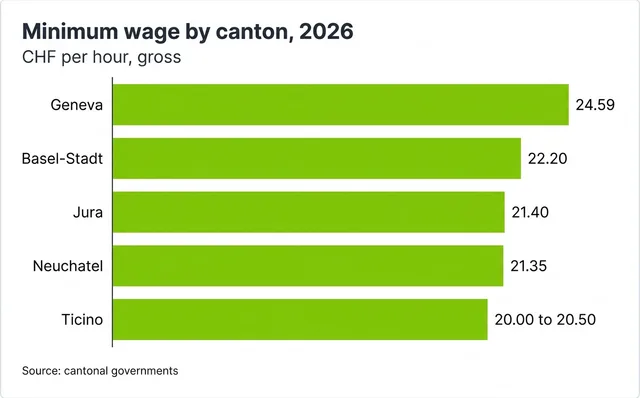
Geneva: CHF 24.59 an hour
Geneva has the highest minimum wage in Switzerland. It rose from CHF 24.48 in 2025 to CHF 24.59 an hour from 1 January 2026. Agriculture has its own lower rate of CHF 18.07. At 40 hours a week the general rate comes to roughly CHF 4,262 a month, and at 42 hours to about CHF 4,475. If you are looking at roles in the city, our list of English-speaking jobs in Geneva shows what is open right now.
Basel-Stadt: CHF 22.20 an hour
Basel-Stadt raised its minimum from CHF 22.00 to CHF 22.20 an hour on 1 January 2026, and the law requires a new adjustment every year. The canton lists who is not covered: apprentices, interns, family members working in the business, and employees in sectors with a generally binding collective labour agreement. At 40 hours a week, CHF 22.20 is about CHF 3,848 a month. Basel’s pharma and life-sciences employers mostly pay well above this, as you can see in English-speaking jobs in Basel.
Jura: CHF 21.40 an hour
Jura’s minimum has been CHF 21.40 an hour since 1 July 2024, when it rose from CHF 20.60. The canton’s page shows no change for 2026. At 40 hours a week that is about CHF 3,709 a month.
Neuchâtel: CHF 21.35 an hour
For 2026 Neuchâtel’s rate is CHF 21.35 an hour, up from CHF 21.31, with CHF 18.15 for agriculture. At 40 hours a week the general rate is about CHF 3,701 a month.
Ticino: CHF 20.00 to CHF 20.50 an hour
Ticino is the only canton with a range rather than a single figure. Its minimum is CHF 20.00 to CHF 20.50 an hour depending on the sector, valid from 1 January to 31 December 2026. At 40 hours a week that is about CHF 3,467 to CHF 3,553 a month. Ticino also has the lowest median pay of any Swiss region, which we come back to below. Roles there that only need English are listed under jobs in Lugano and Ticino.
What the minimum wage means per month
Swiss job ads and contracts usually quote monthly or yearly pay, while the cantonal minimums are hourly. To compare them, multiply the hourly rate by your weekly hours, then by 52 weeks, and divide by 12 months.
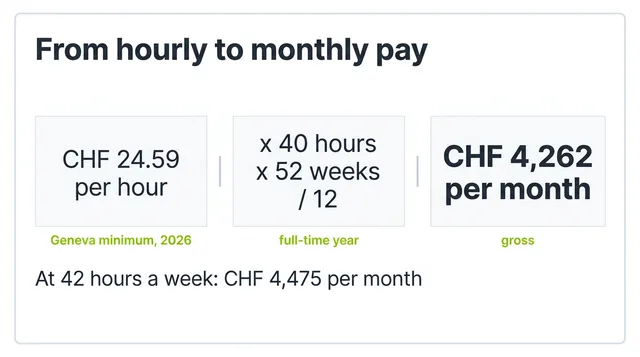
Weekly hours matter more than people expect. Full-time contracts do not all use the same week, so check yours: two extra hours a week add about CHF 213 a month at the Geneva rate. Here is the same calculation for every canton at 40 hours a week.
- Geneva: CHF 24.59 an hour, about CHF 4,262 a month.
- Basel-Stadt: CHF 22.20 an hour, about CHF 3,848 a month.
- Jura: CHF 21.40 an hour, about CHF 3,709 a month.
- Neuchâtel: CHF 21.35 an hour, about CHF 3,701 a month.
- Ticino: CHF 20.00 to 20.50 an hour, about CHF 3,467 to 3,553 a month.
Two cautions when you compare a job offer with these numbers. First, they are gross. Social security contributions, occupational pension contributions and, for many foreign workers, withholding tax come off before the money reaches your account. Second, some Swiss employers pay a 13th monthly salary. If your offer is quoted as an annual figure paid in 13 instalments, divide the annual total by 12 before you compare it with the monthly figures here.
Zurich and Winterthur: city minimum wages on hold
The canton of Zurich has no minimum wage, but two of its cities voted for their own. The status changed this year, and most guides you will find online are out of date on it.
How we got here
In June 2023, voters in the city of Zurich approved a municipal minimum wage of CHF 23.90 an hour, and Winterthur approved CHF 23.00. In 2024 the Zurich cantonal administrative court annulled both, ruling them incompatible with cantonal law. The cities appealed. On 12 May 2026 the Federal Supreme Court ruled that both municipal ordinances are valid, and each city council now decides when its minimum wage takes effect.
When it starts
Not yet. The city of Zurich says the start date is still open and it will announce it at least six months in advance. We found no official start date for Winterthur when we checked on 6 October 2026. Once in force, the Zurich rate of CHF 23.90 would work out at about CHF 4,143 a month at 40 hours a week. For now, if you work in the city, no statutory minimum applies. Most English-speaking jobs in Zurich are in banking, insurance and tech, where pay sits far above these figures anyway.
How collective labour agreements fit in
Many Swiss sectors have a collective labour agreement, known as a GAV in German and a CCT in French, negotiated between employers and unions. These agreements often set their own minimum wages by job and qualification. When the federal government declares an agreement generally binding, it applies to every employer in that sector, not only to members.
Which rule wins today
It depends on the canton. Basel-Stadt, for example, states that its cantonal minimum does not apply in sectors with a generally binding collective agreement. In practice, if you work in a sector covered by such an agreement, check the agreement’s pay scale as well as the cantonal rate.
The federal law passed in June 2026
Parliament has passed a change to the federal law on generally binding collective agreements. Under it, minimum wages in a generally binding agreement would take precedence over cantonal minimum wages, even where the agreement’s rate is lower. The Federal Council had recommended rejecting the bill because it cuts into cantonal powers, but both chambers approved it in their final votes on 19 June 2026.
The law is not in force. Opponents collected signatures for a referendum, due to be handed in at the Federal Palace on 7 October 2026. If the Federal Chancellery confirms enough valid signatures, Swiss voters will decide. Until then, the cantonal rules above apply as they stand.
Who the minimum wage does not cover
Each canton writes its own exceptions, so read the official page for the canton where you work. Basel-Stadt’s list is typical of what you will find: apprentices, interns, family members in the business, and employees in sectors with a generally binding collective agreement. Geneva and Neuchâtel set a separate, lower rate for agriculture rather than leaving it out.
Your nationality and permit do not change your entitlement. A cantonal minimum applies to the work done in that canton. If you are not an EU or EFTA citizen, there is a second floor that often matters more: to get your permit approved, your salary and employment terms must match local, professional and sectoral conditions, which in skilled jobs is far above the legal minimum. Our guide to Swiss work permits explains how that check works for EU, UK and other applicants.
If you live in one place and work in another
Because the minimum follows the workplace, a cross-border commuter who lives in France and works in Geneva is covered by the Geneva rate, and someone who lives in Basel-Landschaft but works in Basel-Stadt is covered by Basel-Stadt’s. The reverse also holds: living in Geneva gives you no minimum-wage entitlement for a job in Vaud, which has no cantonal minimum. Cross-border commuters from EU and EFTA countries work on a G permit, which our guide to Swiss work permits covers along with the B and L permits most new arrivals start on.
The minimum wage next to what people actually earn
The cantonal minimums are a floor, and most full-time salaries in Switzerland sit well above them. The latest official figures come from the Swiss Federal Statistical Office’s earnings survey for 2024, published in November 2025.
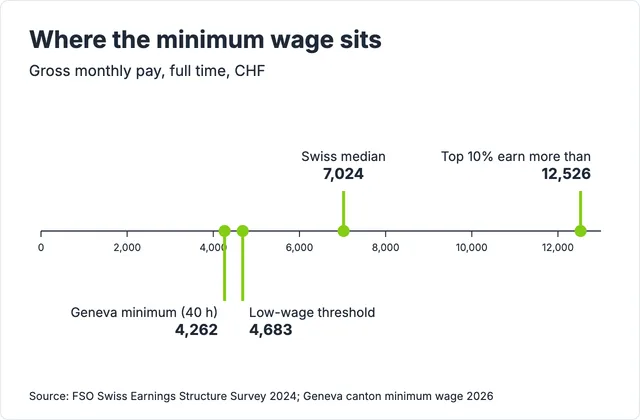
The national median gross wage for a full-time job was CHF 7,024 a month, so half of full-time employees earned more and half earned less. The lowest-paid 10% earned under CHF 4,635 and the top 10% over CHF 12,526. The statistical office defines a low wage as less than two thirds of the median, which is CHF 4,683, and 10.8% of jobs fell below that line. Even Geneva’s minimum at 40 hours a week sits under that threshold.
By region
Median pay ranges from CHF 7,502 a month in the Zurich region to CHF 5,708 in Ticino. Northwestern Switzerland, which includes Basel, sits at CHF 7,156, Central Switzerland including Zug at CHF 7,092, the Lake Geneva region at CHF 6,998, Espace Mittelland including Bern at CHF 6,964, and Eastern Switzerland at CHF 6,623.
By sector
The gap between sectors is wider still. Banks had a median of CHF 10,723, pharmaceuticals CHF 10,159 and IT services CHF 9,874. At the other end, retail paid a median of CHF 5,214, restaurants CHF 4,744, accommodation CHF 4,715 and personal services CHF 4,496. The jobs where the cantonal minimum actually bites are concentrated in those lower-paid sectors.
What this means when you apply for jobs in Switzerland
For most people reading this site, the minimum wage is a safety net rather than a target. Roles where English is the only language required tend to be in international companies, in fields like tech, finance and life sciences, where the median pay figures above are the more useful benchmark. Three practical steps follow from the numbers.
Check the canton of the workplace, not the company’s headquarters, before you judge an offer against a legal minimum. Convert every offer to the same basis, monthly over 12 months at your contract’s weekly hours, so you compare like with like. And if you need a permit, expect the employer’s offer to be measured against local pay for that job, not against the minimum wage.
Getting to the offer stage is the harder part. Swiss employers expect a CV that follows local conventions, with your nationality and permit status near the top. If yours is still in another country’s format, you can rebuild it in English with Careerkit’s free CV builder, add a short cover letter that states your permit status with the cover letter builder, then browse all English-speaking jobs in Switzerland that are open today. Our step-by-step guide to getting a job in Switzerland covers the rest of the process, and if you are wondering whether you can work here without German or French, start with this guide to working in English.
FAQ
What is the minimum wage in Switzerland?
There is no national minimum wage. Five cantons have one in 2026: Geneva CHF 24.59 an hour, Basel-Stadt CHF 22.20, Jura CHF 21.40, Neuchâtel CHF 21.35 and Ticino CHF 20.00 to 20.50 depending on the sector. All are gross hourly rates.
What is the minimum wage in Switzerland per month?
At 40 hours a week, the cantonal minimums work out at about CHF 3,467 a month in Ticino up to about CHF 4,262 in Geneva, before deductions. Multiply the hourly rate by your weekly hours and 52, then divide by 12.
Is there a minimum wage in Zurich?
Not yet. The canton has none. The city of Zurich approved CHF 23.90 an hour in 2023 and the Federal Supreme Court upheld it on 12 May 2026, but the city has not set a start date and will give at least six months’ notice.
Is 5,000 CHF a good salary in Switzerland?
It is above every cantonal minimum and above the official low-wage threshold of CHF 4,683 a month, but well below the national median of CHF 7,024 for full-time work in 2024. In Ticino, where the regional median is CHF 5,708, it is closer to typical pay than in Zurich, where the median is CHF 7,502.
Is 7,000 CHF a good salary in Switzerland?
CHF 7,000 a month is almost exactly the national median of CHF 7,024 for full-time work in 2024. It is a little under the Zurich region median of CHF 7,502 and above the medians in the Lake Geneva region, Espace Mittelland, Eastern Switzerland and Ticino.
What is the lowest paying job in Switzerland?
By sector, the lowest median pay in 2024 was in personal services at CHF 4,496 a month, followed by accommodation at CHF 4,715 and restaurants at CHF 4,744, according to the Swiss Federal Statistical Office.
Conclusion
Switzerland’s minimum wage is a cantonal patchwork: five cantons with a legal floor in 2026, led by Geneva at CHF 24.59 an hour, two cities whose approved minimums are waiting for a start date, and a federal law on collective agreements that a referendum may still stop. Check the canton where you would work, convert any offer to a monthly figure on the same hours, and judge it against median pay for your field as well as the legal floor. When you are ready to apply, the live list of English-speaking jobs is updated every hour.
Ready to look? Browse 1,828 English-speaking jobs in Switzerland.