Cost of living in Switzerland in 2026: what rent, insurance and everyday life cost
By Nishant Modi, Founder of Careerkit, based in Zurich · Published 10 November 2026

Switzerland is the second most expensive country in Europe. In 2025 its prices for household spending stood at 171% of the EU average, behind only Iceland at 174% and about 30% above the United States. The biggest gaps are in the costs you cannot avoid: housing and energy cost more than twice the EU average, and so does health.
Salaries are high too, so the useful number is what is left at the end of the month. This guide gives you the official figures for rent, health insurance, transport and food, shows what an average Swiss household spends, and adds up the fixed costs for one person moving to Zurich.
How expensive is Switzerland?
Eurostat compares price levels across Europe every year, with the EU average set at 100. In its 2025 figures, published in June 2026 and still preliminary, Switzerland scored 171 for household spending overall. Iceland was at 174, Denmark at 140 and the United States at 133.
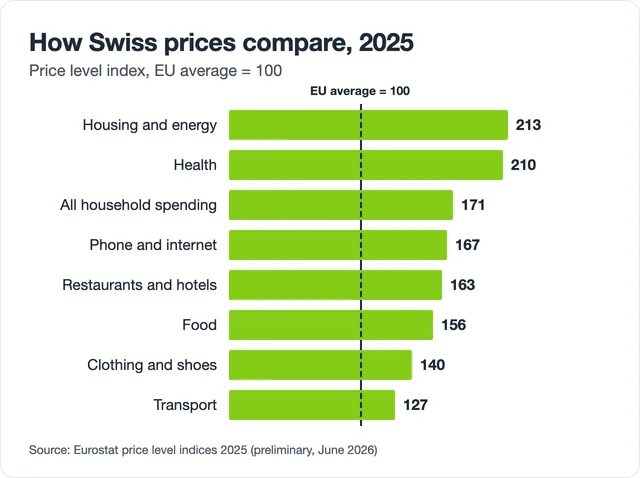
The spread across categories matters more than the headline. Housing, water, electricity and gas stood at 213 and health at 210, more than double the EU level. Information and communication, which covers phones and internet, was at 167, restaurants and hotels at 163 and food at 156. Transport was the least out of line at 127. So the bills you pay every month whatever you do, rent and health insurance, are where Switzerland costs most.
Prices themselves barely moved last year: average inflation in 2025 was 0.2%. Health insurance is the exception, as you will see below.
Rent in Switzerland
Rent is the largest single cost for most people who move here, and what you pay depends heavily on when the contract was signed.
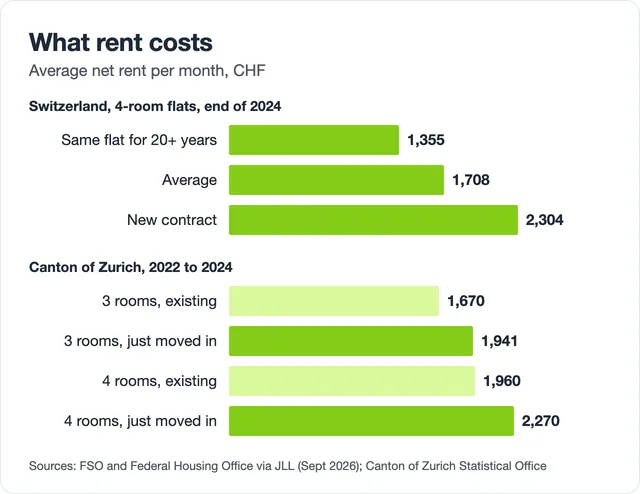
At the end of 2024 the average net rent for a four-room flat in Switzerland was CHF 1,708 a month, CHF 38 more than a year earlier. Households that had lived in the same four-room flat for more than 20 years paid CHF 1,355, while people on a new contract for a similar flat paid CHF 2,304. As a newcomer you sign a new contract, so plan with the higher figure. In Swiss listings the living room counts as a room, so a four-room flat usually has three bedrooms.
The highest rents were in the cantons of Zug, Zurich and Schwyz and the lowest in Jura, Neuchâtel and Uri. In the canton of Zurich, existing tenancies averaged CHF 1,670 for three rooms and CHF 1,960 for four rooms over 2022 to 2024, while people who had just moved in paid CHF 1,941 and CHF 2,270, and the highest rents in the canton are in the city of Zurich and the lake towns near it. Net rent is the rent before service charges for heating, hot water and similar costs, which come on top.
Budget for a deposit as well. For a home, a landlord may ask for at most three months’ rent as security and must keep it in a bank account in your name. If you are looking at roles in the priciest areas, compare what is open in Zurich and Zug with places where rents are lower.
Health insurance
Basic health insurance is compulsory. Anyone who takes up residence in Switzerland must take it out within three months, and if you join within that window the cover starts on the day you arrived, so premiums are charged from that date too.
Premiums are paid per person, not per household, and they rose again for 2027. For 2027 the average premium is CHF 412 a month, up 5.0%: CHF 487.60 for adults, CHF 338.80 for young adults and CHF 128.10 for children. What you pay depends on your canton and region, your insurer, the deductible you choose and the insurance model. The federal comparison site Priminfo lists every insurer’s premium for your postcode. For a couple without children, the national averages mean almost CHF 1,000 a month before anyone sees a doctor.
Transport, food and eating out
Transport is where Swiss prices are closest to the rest of Europe, and food is where your own choices change the bill most.
Public transport
The GA travelcard gives unlimited travel on most trains, buses, trams and boats in Switzerland. A second-class GA costs CHF 3,995 a year and rises to CHF 4,095 in December 2026, while first class goes from CHF 6,520 to CHF 6,770. At the new price a second-class GA works out at about CHF 341 a month. If you mostly travel within one city, check the price of a local pass for your zones first.
Groceries and restaurants
In 2025 food cost 56% more than the EU average and restaurants and hotels 63% more. Both are well below the premium on rent and health, so this is where cooking at home and comparing supermarkets pays off.
What an average Swiss household spends
The Federal Statistical Office’s household budget survey shows where the money goes. In 2023 the average household, with 2.07 people, had a disposable income of CHF 7,186 a month after taxes, social insurance and compulsory health insurance.
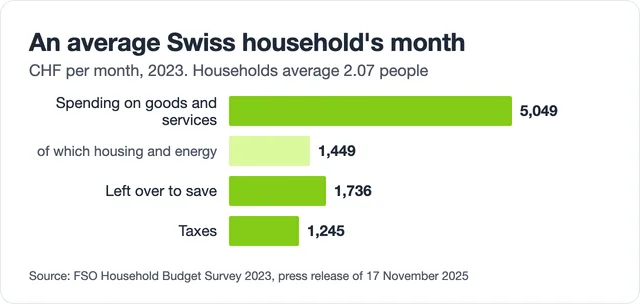
Households spent CHF 5,049 a month on goods and services, 48.8% of their gross income. Housing and energy was the biggest item at CHF 1,449 a month, up from CHF 1,374 the year before. Taxes averaged CHF 1,245 a month, or 12.0% of gross income, social insurance contributions such as pension contributions took another 10.3%, and compulsory health insurance premiums 6.7%. On average CHF 1,736 a month was left over to save.
An average hides a wide spread. About 61% of households had less disposable income than the average, and households in the lowest income bracket, many of them retirees, often spent more than they took in.
Fixed costs for one person moving to Zurich
Here is what the official figures add up to for one adult who moves to the canton of Zurich and signs a new lease. It is an illustration built from the averages above, not a quote for your situation.
- Rent: CHF 1,941 a month for a three-room flat, the canton average for people who had just moved in.
- Health insurance: CHF 487.60 a month, the national average adult premium for 2027.
- Public transport: about CHF 341 a month, a second-class GA at the December 2026 price spread over 12 months.
That is about CHF 2,770 a month before food, phone, electricity, household insurance and taxes. Set against a median full-time salary of CHF 7,024 a month gross, these fixed costs take about 39% of it. Our guide to average salaries in Switzerland breaks that median down by region, sector and permit, so you can run the same sum for your own field. For a family the total climbs quickly, because health insurance is paid for each person and the flat needs more rooms.
Taxes depend heavily on your canton and municipality. The Federal Tax Administration’s tax calculator shows the amount for your income and place of residence. If you are still job hunting, these numbers help you judge an offer before you accept it, and the first step is a CV in the format Swiss employers expect, which you can build in English with Careerkit’s free CV builder.
How to keep costs down
The biggest savings come from the two fixed costs, rent and health insurance, not from cutting small daily spending.
- Compare basic health insurers on Priminfo every autumn. The cover is the same by law, but premiums differ between insurers and models, and you can change insurer for the next year.
- Choose a higher deductible if you rarely see a doctor. You carry more of the cost when you do, and pay a lower premium every month in return.
- Look beyond the most expensive areas. Zug and Zurich have the highest rents, and a slightly longer commute can cut the biggest line in your budget.
- Match your travel pass to how you actually travel. A GA pays off if you cross the country often; for one city a local pass usually costs less.
When you are ready to move from budgeting to applying, browse the English-speaking jobs open in Switzerland today, including roles in Zurich, Geneva and Basel, and send each one with a short cover letter from the cover letter builder. Our guides to Swiss work permits and getting a job in Switzerland cover the steps before the move, and this guide explains whether you can work here in English only.
FAQ
Is Switzerland expensive to live in?
Yes. In 2025 Swiss prices for household spending were 71% above the EU average, second in Europe only to Iceland, according to Eurostat. Housing and energy were more than twice the EU level, and so was health.
How much do you need to live in Switzerland per month?
In 2023 the average household of 2.07 people spent CHF 5,049 a month on goods and services and paid CHF 1,245 a month in taxes. For one adult moving to Zurich, rent, health insurance and a travelcard alone come to about CHF 2,770 a month before food and taxes.
What is the cost of living in Zurich?
Zurich is one of the most expensive cantons for rent. People who had just moved in paid an average of CHF 1,941 a month for three rooms and CHF 2,270 for four rooms over 2022 to 2024. Add about CHF 488 for health insurance at the national adult average and CHF 341 for a GA travelcard.
How much is health insurance in Switzerland?
The average basic premium for 2027 is CHF 412 a month, 5.0% more than in 2026: CHF 487.60 for adults, CHF 338.80 for young adults and CHF 128.10 for children. It is compulsory within three months of moving to Switzerland.
How much is rent in Switzerland?
The average net rent for a four-room flat was CHF 1,708 a month at the end of 2024. New contracts averaged CHF 2,304 for a similar flat. Landlords may ask for a deposit of up to three months’ rent.
Is Switzerland more expensive than the US?
Yes. Eurostat’s 2025 price levels put Switzerland at 171 and the United States at 133, against an EU average of 100, so Swiss prices for household spending were roughly 30% higher.
Conclusion
Switzerland costs about 71% more than the EU average, and most of the gap sits in rent and health insurance. A newcomer in Zurich should plan around CHF 2,000 a month for a three-room flat on a new lease and almost CHF 500 for health insurance, before food and taxes. Check the salary for your field against those fixed costs, then use the live list of English-speaking jobs, updated every hour, to find roles that make the numbers work.
Ready to look? Browse 2,200 English-speaking jobs in Switzerland.