The Swiss B permit in 2026: who gets one, how long it lasts and what it lets you do
By Nishant Modi, Founder of Careerkit, based in Zurich · Published 10 November 2026
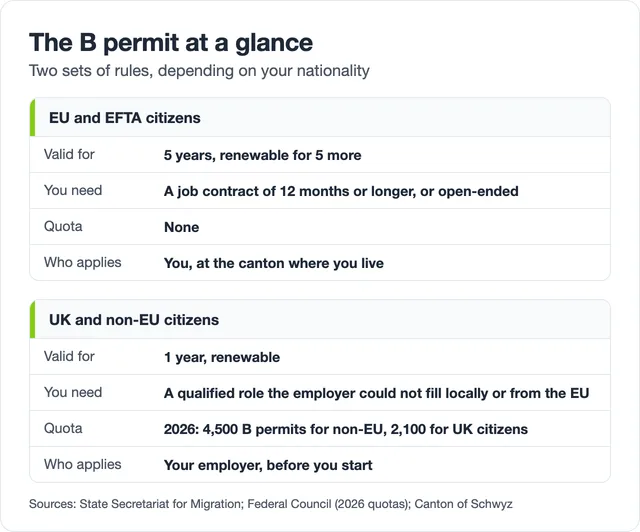
The B permit is the Swiss residence permit for people who move here for a longer stay, and for most people who come to work it is the permit they live on. What it gives you depends on your nationality. For EU and EFTA citizens it is valid for five years and comes with a job contract. For UK and other non-EU citizens it is valid for one year at a time, counts against an annual quota and has to be applied for by the employer.
This guide covers both versions, what the permit lets you do once you have it, how tax works while you hold one, and how it leads to a C permit. For the full picture of Swiss permits, including the L and G permits, start with our overview of Swiss work permits.
The B permit for EU and EFTA citizens
Under the free movement agreement, the B permit is a matter of having the job. It is issued to EU and EFTA citizens with an employment contract of at least twelve months or of unlimited duration, it is valid for five years, and it can be renewed for another five if you still meet the requirements. You apply at the canton where you live; your employer does not have to prove that no Swiss candidate was available.
There is one condition to know about. If you have been involuntarily unemployed for more than twelve consecutive months, the first renewal can be limited to one year. EU and EFTA citizens without a job can also get a B permit if they show sufficient financial means and adequate health and accident insurance.
The B permit for UK and non-EU citizens
Since 2021 UK citizens who start work in Switzerland fall under the same system as other non-EU nationals, with a separate quota of their own. Here the employer applies, and the permit has to fit within the limits set each year.
Who qualifies
The State Secretariat for Migration admits workers from outside the EU and EFTA only for qualified roles: managers, specialists and other qualified workers. The employer has to show it could not find a suitable person in Switzerland or the EU and EFTA, and pay and conditions must match what is usual locally for the region and sector. In the canton of Schwyz’s words, the B permit is issued within the cantonal quota mainly to people in executive positions and specialists.
The 2026 quotas
For 2026 the Federal Council set 4,500 B permits for qualified workers from non-EU countries, alongside 4,000 L permits, and a separate quota for UK citizens of 2,100 B and 1,400 L permits. The quotas are shared out between the cantons, so a large employer with experience of the process is often the easiest route.
How long it lasts
For UK and other non-EU citizens the B permit is valid for one year and can be renewed. At renewal the canton checks the reasons and conditions it was granted on, so a promise made in the application, such as the role you were hired for, carries on mattering.
Changing jobs, moving canton and living abroad
Once you hold a B permit you have more freedom than with an L permit, with a few limits worth knowing.
- Changing jobs: as a general rule, B permit holders can change job without further authorisation. The exception is a permit granted for one specific job and expressly tied to a labour-market condition; then you apply to the canton first.
- Working anywhere in Switzerland: a B permit holder allowed to work can do so in the whole of Switzerland, not only in the canton that issued the permit.
- Moving to another canton: someone with a residence permit who moves their home to another canton needs a permit from the new canton. Apply there before you move.
- Self-employment: non-EU citizens can work for themselves, but admission depends on a review of labour-market conditions.
- Time in Switzerland: the permit means your life is centred here. Holders are expected to be in Switzerland for at least 180 days a year.
Bringing your family
For UK and non-EU citizens, family reunion is possible for the spouse and dependent children of B permit holders, while it is not guaranteed for holders of an L permit. That difference is one reason to aim for a B rather than an L permit if you plan to move with a partner or children. The canton sets the details, so ask its migration office about housing and income requirements before you apply.
Tax at source on a B permit
Most B permit holders pay income tax at source: the employer deducts it from your salary each month. The framework is federal and each canton applies it; this is how the canton of Zurich’s tax office describes it.
- You are taxed at source if you work for a Swiss employer and do not have a C permit, unless you are married to someone with a C permit or Swiss citizenship.
- If you earn at least CHF 120,000 gross a year from employment, a subsequent ordinary assessment is compulsory, so you file a tax return as well. Spouses’ salaries are not added together to reach the threshold.
- Below that, you can apply for an ordinary assessment to claim deductions you would otherwise lose. The application is due by 31 March of the following year.
- When you receive a C permit, tax at source stops from the following month and you file a normal tax return.
To see what your gross salary is worth against typical pay, our guide to average salaries in Switzerland shows the median by region, sector and permit, and the cost of living guide shows where the money goes.
From a B permit to a C permit
The C permit is the settlement permit: it is not limited in time and it ends tax at source. You get it after years of living in Switzerland on a B permit, and the waiting time and conditions depend on your nationality and integration. Keep your B permit renewed without gaps, because the years you live here on it are what count towards settlement.
What this means for your job search
If you are an EU or EFTA citizen, apply like a local and mention that you are eligible for a B permit with a job contract. If you are from the UK or elsewhere, aim for roles where you are clearly a specialist, at employers used to the permit process. Either way, state your nationality and current permit near the top of your CV, so the employer does not have to ask.
Before: Open to relocating to Switzerland.
After: German citizen, eligible for a Swiss B permit with an employment contract. Available to start in March.
Before: Visa sponsorship may be required.
After: Indian citizen, currently on a Swiss B permit in Basel; changing jobs does not need a new permit.
The second example only applies if your permit is not tied to a specific job, so check yours first. You can put this in a Swiss-format CV in English with Careerkit’s free CV builder and repeat it in a short cover letter. Then browse English-speaking jobs in Switzerland, including Zurich, Basel and Geneva.
FAQ
How long is a B permit valid in Switzerland?
For EU and EFTA citizens a B permit is valid for five years and can be renewed for five more. For UK and other non-EU citizens it is valid for one year at a time and renewed by the canton.
Who can get a B permit in Switzerland?
EU and EFTA citizens with a job contract of at least twelve months or of unlimited duration, or with enough money and insurance if they do not work. UK and other non-EU citizens can get one for a qualified role that the employer could not fill from Switzerland or the EU, within the annual quota.
How many B permits are there for non-EU citizens in 2026?
The Federal Council set 4,500 B permits for qualified workers from non-EU countries for 2026, plus a separate quota of 2,100 B permits for UK citizens.
Can I change jobs with a B permit?
As a general rule, yes, without further authorisation. If your permit was granted for one specific job and tied to a labour-market condition, apply to the canton before you switch.
Do B permit holders pay tax at source?
Yes, if they work for a Swiss employer and are not married to a Swiss citizen or C permit holder. From CHF 120,000 gross a year a tax return is compulsory as well, and below that you can apply for an ordinary assessment by 31 March of the following year.
What is the difference between a B and a C permit?
The B permit is a residence permit that is renewed periodically. The C permit is the settlement permit, which is not limited in time, comes after years in Switzerland and ends tax at source from the month after you receive it.
Conclusion
The B permit is the standard permit for working in Switzerland, but it works very differently by nationality. EU and EFTA citizens get five years with a job contract. UK and other non-EU citizens get a year at a time, inside a quota of 4,500 for 2026, for qualified roles their employer applies for. Once you have it, you can usually change jobs freely, work anywhere in the country and, after enough years, move on to a C permit. When you are ready to apply, the live list of English-speaking jobs is updated every hour.
Ready to look? Browse 2,244 English-speaking jobs in Switzerland.