UN jobs in Geneva in 2026: how hiring works and where to apply
By Nishant Modi, Founder of Careerkit, based in Zurich · Published 10 November 2026

Switzerland hosts about forty international organisations with more than 25,000 employees, alongside nearly 400 NGOs, and more than 175 UN member states are represented in Geneva.
It is also a harder market than it was two years ago. International Geneva has lost more than 2,800 jobs since early 2025, when the United States announced cuts to its UN funding, with cuts by other countries adding to the losses. Staff numbers fell from 25,696 in 2024 to just under 23,000, not counting NGOs, and IOM, UNHCR and WHO were among the organisations that cut posts. This guide explains where the openings are posted, the six ways in, how pay works, and the permit rules for you and your family.
Where UN jobs in Geneva are advertised
Each organisation hires through its own careers site, so the first step is knowing which sites to watch.
- UN Careers: careers.un.org carries openings for the UN Secretariat, including the UN Office at Geneva. The UN Office at Geneva advises checking the careers pages of the other Geneva-based UN entities as well.
- Agency career sites: specialised agencies and programmes such as WHO, UNHCR, the ILO, WIPO, ITU and IOM advertise on their own sites.
- International Geneva job lists: the jobs page on geneve-int.ch and the CAGI recruitment platform list openings across International Geneva.
Some international employers also post where our list picks them up. In 2026 so far, Careerkit’s job board has collected 184 ads from CERN in Geneva, plus roles at the World Economic Forum and Médecins Sans Frontières. The ones that only need English appear among the English-speaking jobs in Geneva.
The six ways into the UN in Geneva
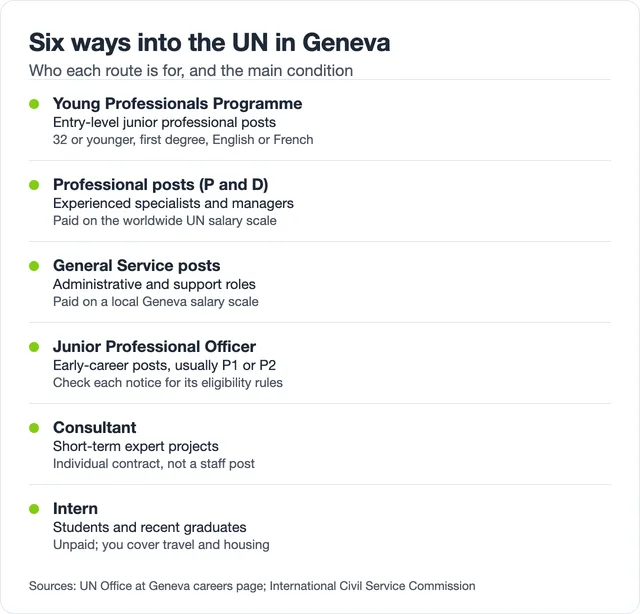
The UN does not hire everyone the same way. Which route fits you depends mostly on your age and experience.
Young Professionals Programme
Entry-level junior professional posts are filled exclusively through the Young Professionals Programme. To take part you need a first-level university degree in the relevant field, you must be 32 or younger, and you must be fluent in English or French.
Professional and General Service posts
Most staff posts fall into two groups. Professional and higher posts, graded P and D, are paid on salary scales applied worldwide, made up of a base salary and a post adjustment, both in US dollars. The post adjustment is a cost-of-living element that keeps pay equivalent between duty stations. General Service posts, the administrative and support roles, are paid on local salary scales, and Geneva is one of the headquarters cities where the International Civil Service Commission surveys local pay itself.
In practice a General Service salary follows Geneva’s labour market, while a Professional salary is set within the global UN system. The commission publishes the current scales and post adjustment figures, so check them for the grade in any notice that interests you. For context, the median full-time salary in Switzerland is CHF 7,024 a month, which our guide to average salaries in Switzerland breaks down by sector and permit.
Junior Professional Officers
Junior Professional Officer positions are generally at the P1 or P2 level. Eligibility is set out in each notice, so read that section before you apply.
Consultants
The UN frequently engages experts under individual contracts to work on short-term projects. A consultancy is a contract, not a staff post, so it comes without the pay scale and permit arrangements described here.
Internships
Internships at the UN Office at Geneva are not paid, and visas, travel and accommodation are the responsibility of the interns or their sponsoring institutions. Other organisations in Geneva set their own internship terms, so check each notice. Geneva is an expensive place to live without a salary: our cost of living guide shows what rent and health insurance cost before you commit.
Permits: the legitimation card and your family
Staff of international organisations do not get an ordinary Swiss permit. The legitimation card issued by the FDFA serves as their residence permit and confirms the privileges and immunities that come with the post.
The card does not let anyone work outside the organisation. Under no circumstances may a person work with their legitimation card, even as a volunteer. Spouses and children who live with the staff member can instead get a Ci permit, issued in exchange for the card. Children must have arrived for family reunification before the age of 21. The application goes to the population office of the canton where you live, it is subject to a fee, and the permit runs for the length of the work contract, up to two years at a time.
Ci permit holders pay Swiss tax and social insurance on their earnings. If your partner plans to work in Switzerland, check these rules before you accept an offer. For jobs outside international organisations the usual permits apply, which our guide to Swiss work permits explains.
Languages
The Young Professionals Programme requires fluency in English or French. For other posts the language requirements are set in each job notice, so read that section first. Outside the office, Geneva is a French-speaking city, which matters for daily life and for a partner looking for local work. If you are weighing Geneva against other cities, our guide to working in Switzerland in English covers where English alone is enough.
How to make your application stand out
Every UN job notice lists the experience, education and languages it requires. Write each entry in your application so the match is clear to someone reading quickly: the scale of the work, the setting, and the result.
Before: Responsible for project management in several countries.
After: Managed a three-country health project with a USD 2.4 million budget, reported to two donors and delivered every milestone on schedule.
Before: Good communication skills.
After: Drafted and presented quarterly briefings in English and French for government counterparts and the country director.
Many international organisations use their own online application forms, but you still need a strong CV for consultancies, NGO roles and networking. Build one in English with Careerkit’s free CV builder and write a matching cover letter. If you also want options outside the international sector, browse the English-speaking jobs in Geneva and across Switzerland, and see our step-by-step guide to getting hired here.
FAQ
How do I get a job at the UN in Geneva?
Watch careers.un.org for UN Secretariat posts, the career sites of agencies such as WHO, UNHCR and the ILO, and Geneva-wide lists such as geneve-int.ch and CAGI. Then pick the route that fits you: the Young Professionals Programme if you are 32 or younger, Professional or General Service posts if you have experience, or a consultancy.
How many people work for international organisations in Geneva?
The Swiss foreign ministry puts it at more than 25,000 employees across about forty international organisations. Figures reported in September 2026 show International Geneva at just under 23,000 staff, down from 25,696 in 2024, after more than 2,800 jobs were lost since early 2025.
Are UN internships in Geneva paid?
Internships at the UN Office at Geneva are not paid, and interns or their sponsoring institutions cover visas, travel and accommodation. Other organisations in Geneva set their own internship terms, so check each notice.
Do UN staff in Geneva need a Swiss work permit?
No ordinary permit is needed. Staff of international organisations receive a legitimation card from the Swiss foreign ministry, which serves as their residence permit. The card does not allow any work outside the organisation.
Can my partner work in Switzerland if I work for the UN in Geneva?
Yes. A spouse who lives with you can exchange the legitimation card for a Ci permit through the population office of your canton. It covers the length of the work contract, up to two years at a time, and the holder pays Swiss tax and social insurance.
Do I need French to work at the UN in Geneva?
The Young Professionals Programme asks for fluency in English or French. Other posts set their language requirements in each notice. French helps with daily life in Geneva, which is a French-speaking city.
Conclusion
International Geneva still employs more than 20,000 people, but there are fewer jobs after the 2025 cuts, so apply where you clearly fit. Watch careers.un.org and the agency sites, pick the route that matches your age and experience, check the permit rules for your family early, and write every application entry against the notice’s requirements. For roles outside the UN system, the live list of English-speaking jobs is updated every hour.
Ready to look? Browse 2,203 English-speaking jobs in Switzerland.